Donut Coin
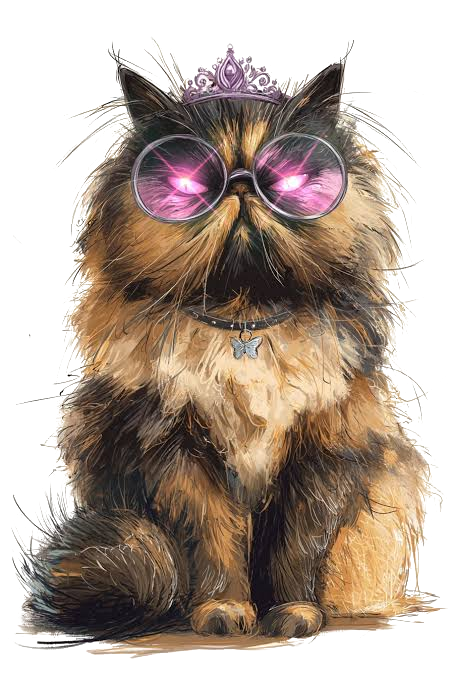
Princess Donut, the Queen Anne Chonk. No value, all fun.
Donut Coin: a white paper
Revised 17 September 2026, after checkpoints, the reorg cap, open mining and the market went in.
Abstract
Donut Coin is a proof-of-work cryptocurrency named after a cat. It has no use, no value, no roadmap and no team, and it works. This paper describes how.
1. Genesis, the true story
On the evening of 2026-09-16 the coin’s creator asked Princess Donut herself, through askdonut.ai, what a memecoin named after her should be called. Her answer, verbatim:
“A memecoin named after me would be called ‘Princess Donut.’ You may add ‘The Queen’ if you like. It will rise to power and then collapse in a way that makes sense, just as I do.”
So the coin is Donut Coin, its unit is the DONUT, and its mascot and sovereign is Princess Donut, the Queen Anne Chonk. The genesis block that carries her words was mined that night at 22:00 Eastern. Everything else in this paper is what it took to make her prophecy technically possible.
1a. Motivation
Most coins exist to be worth something. Donut Coin exists so that one nerd who loves DCC could watch a chain of blocks arrive on a server in a closet and understand every line that made it happen. It is Doge-like in spirit: fun first, and honest about being fun. If it ever becomes worth anything, that was an accident and you should be suspicious of it.
2. Consensus
| Parameter | Value |
|---|---|
| Proof of work | Scrypt, N=1024 r=1 p=1, over an 80-byte header (Dogecoin’s algorithm) |
| Block target | 60 seconds |
| Difficulty retarget | every 10 blocks, limited to a 4x change either way |
| Block reward | 10,000 DONUT, forever; there is no halving and no cap |
| Units | 1 DONUT = 100,000,000 sprinkles. Above that, four units, base 10: Ribbon (1,000,000 DONUT, 100 blocks, about 1 h 40 of the whole network), Tiara (10 Ribbons, about a day), Crown (10 Tiaras, about a week), Queen (10 Crowns, about ten weeks). They follow what Princess Donut wins, what she wears, what she rules under, and who she is, and they stop at the Queen: she named herself one in the genesis block, and a crown is an object while a queen is the person wearing it. Everything under a Ribbon is quoted in DONUT. |
| Coinbase maturity | 3 blocks, becoming 21 at block 3,444. A reorg returns an ordinary payment to the mempool, because the coins it spends existed before the fork; it destroys a coinbase, so anything spending one becomes permanently invalid and whoever was paid simply loses it. 21 is not a margin of taste: the reorg cap refuses anything deeper than 20, so 21 is past the deepest undoing possible, and it is the same number the market and the explorer already call final. |
| Block limits | at most 500 transactions, and at most 3,000 inputs and outputs across all of them; at most 2,000 inputs and 500 outputs in any one transaction. Every input costs a signature check, so these are what bound the work a block can force on every node: about four and a half seconds at the limit. The busiest block so far used 16% of it. |
| Policy, not consensus | separately from the rules above, a node decides what it will relay and build. This one builds blocks up to 2,250 inputs and outputs (three quarters of the cap, the ratio Dogecoin uses), refuses outputs under 0.01 DONUT as dust, and holds at most 5,000 waiting transactions. A block breaking any of these is still perfectly valid; the node simply will not be the one to make it. Anyone may set their own, and changing them needs no fork. The point is that with no fee floor a spammer needs no hashrate: they would post fat transactions and honest miners would write them into the chain for nothing. |
| Fork choice | the chain with the most cumulative work, within two limits below |
| Checkpoints | certain heights are pinned to a known block id in the code (height 60 today; one is added with each release from a block a few hours old). Nothing at or below the newest checkpoint can be replaced, whatever work a rival chain carries |
| Starting a node | a node replays its chain from disk on start. At or below the newest checkpoint it skips the proof of work and the signatures: the checkpoint already settles what that history is, and every block names its parent, so a single changed byte breaks a link and the load fails. Above it everything is verified in full. Measured at height 3,457 this is 16 times faster, and it keeps startup roughly constant as the chain grows rather than growing with it. Run with DONUTCOIN_VERIFY_ALL=1 to check every block from genesis instead. |
| Reorg cap | above the newest checkpoint, a heavier chain may replace at most the last 20 blocks. A real reorg is one or two blocks; anything deeper is refused as an attack or a broken node |
| Settlement | the market treats a payment as final at 21 confirmations, one more than the cap, about 21 minutes |
| Genesis | Block 0, 2026-09-17 02:00 UTC (2026-09-16, 22:00 Eastern), nonce 1,483,506. Its message, verbatim: “Princess Donut, The Queen, named herself via askdonut.ai, 2026-09-16: ‘It will rise to power and then collapse in a way that makes sense, just as I do.’” |
3. Transactions
Coins are unspent transaction outputs. A transaction consumes outputs it can sign for (secp256k1 ECDSA over the transaction id) and creates new ones. Whatever is not spent to an output is the fee, paid to the miner of the block. Addresses are Base58Check with Dogecoin’s version byte, which is why they start with D. A wallet is a single key pair in a file.
Notes. Every transaction carries a text field of up to 280 characters, signed with the rest of the transaction; a coinbase carries the miner’s tag, up to 64. Both limits are consensus rules. A note needs no timestamp or author of its own: the block that includes it fixes the time, and the signature fixes who wrote it. Notes are public and permanent; the explorer lists them, and nobody, the operators included, can edit or remove one.
Who may write. From block 560, four consensus rules: one note per block; the signer must have found a block within the last 10,080 blocks (a licence, about a week, renewed by mining); the signer must hold at least a Ribbon at that height; and the note pays a fee of at least 100 DONUT, one percent of a block. Speech is earned by work and expires with it. Two more rules belong to the public site rather than the chain: a note is shown only when its signer has a @username, and the operators keep a hide list of notes the site will not display. A hidden note is still on the chain; the site simply stops being its billboard.
4. Network
Nodes speak plain HTTP and JSON. A node pushes each block it accepts to its peers and pulls whatever it lacks, plus waiting transactions, every fifteen seconds. Anyone may mine: a block from anyone is accepted if it extends the tip, passes every rule and has valid proof of work; no key, account or permission is involved, and the installers and downloads on this site are the same miner the operator runs. A node can be pointed at new peers only by an operator who holds its secret. The public node at donutcoin.meme is one node among any number; run your own and it will check every block itself and refuse anything the rules refuse.
5. Supply
Uncapped. At one block a minute that is about 5.26 billion DONUT a year, all of it minted to whoever found the blocks. Inflation is the point: nobody should hoard a cat.
6. Security, plainly
What is fixed. Every block at or below the newest checkpoint is permanent: no amount of hashing anywhere can replace it, because every node refuses a chain that disagrees with a pinned block. Above that, a rival chain can replace at most the last 20 blocks. So the worst a stronger miner can do to history is rewrite the last twenty minutes or so, and the market waits twenty-one confirmations before it calls a payment settled.
What is not. The honest hashrate is small: at launch it is one home server’s efficiency cores, tens of thousands of hashes a second. A laptop can join and win a fair share; a machine with more Scrypt throughput than that can win most new blocks, and with them most new coins, and can reorganise the last twenty. That is the nature of a small proof-of-work chain and it is not hidden here.
Who decides checkpoints. The operator does, by putting a block id into the code and releasing it. That is a real point of trust: it means the operator’s view of the chain wins at those heights. It is used only to pin blocks that are already hours old and agreed by every node; it cannot mint coins, move anyone’s coins or undo a payment. Everyone can read the code that does it.
Keys. A wallet key lives in the owner’s browser or in a file on their machine. Site accounts store only a copy encrypted with the owner’s password; the site cannot open, spend, freeze or reset it. Lose the password and the coins are lost.
What has not been done. No independent security review of this code has taken place. The downloads are not signed by Apple or Microsoft. The peer-to-peer market verifies the DONUT leg on the chain and nothing about the money leg. Treat all of it accordingly: this is a hobby coin, worth nothing, run by one person.
7. Roadmap
None is promised. What exists is what the site shows: mining, wallets with usernames, notifications, a market for Apple Cash and Cash App, downloads. Things get added when they are fun, and this paper is rewritten when they change the truth.
8. Disclaimer
Nothing here is an offer, a promise, an investment or financial advice. See the terms.